Inaugural Summit, Backed by ISB-CBI and NSE Emerge, Delivers a Sharp Message: 99.5% of Indian SMEs Stall Below ₹25 Crore. Scaling Is No Longer About Working Harder – It’s About Working Differently.
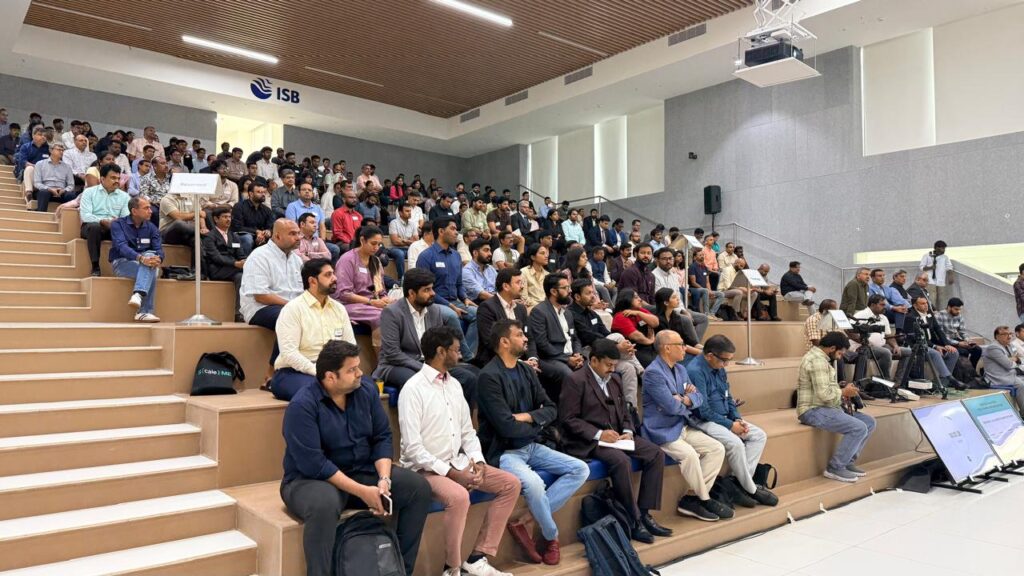
The inaugural ScaleMe SME Growth Summit, held at the Indian School of Business (ISB) on February 21, brought together more than 300 SME leaders, founders and institutional partners for one of India’s most focused conversations on why the country’s mid-market enterprises struggle to scale – and what it will take to change that.
Convened by ScaleMe Network in collaboration with ISB’s Centre for Business Innovation (ISB-CBI) and NSE Emerge, the half-day summit addressed a stark structural reality: while MSMEs contribute nearly 30% of India’s GDPand 46% of exports, 99.5% of them remain below the ₹25 crore revenue mark. The summit set out to unpack why this happens and to lay the institutional groundwork for a different outcome.
What the Summit Revealed: Six Perspectives, One Diagnosis
The speaker line-up was deliberately curated to bring operators, institution builders and capital-market leaders onto the same stage, each tackling a different dimension of the scaling challenge. The result was a rare convergence of practitioner insight that drew sustained engagement – and strong applause – from the room.
1. “The Biggest Risk Is Believing Yesterday’s Playbook Will Work Tomorrow”
Sanjay Enishetty, Founder, ScaleMe
Opening the summit, Sanjay Enishetty called out an “uncomfortable truth”: India’s SME operators are no longer competing only with local rivals. The convenience economy – Blinkit, Zepto, Urban Company and others – has reset customer expectations around speed, access and experience.
Companies that once took a decade to build are now being outpaced by ventures that reach billion-dollar valuations in under three years. His message was pointed:
“For a ₹50 crore business today, the biggest risk isn’t competition – it’s the assumption that tomorrow’s market will reward the same playbook that worked yesterday.”
2. “Stop Obsessing Over EBITDA. Start Thinking Market Cap.”
Prof. Rajendra Srivastava, Executive Director, ISB-CBI
In one of the most paradigm-challenging sessions of the day, Prof. Rajendra Srivastava urged SME operators to look beyond EBITDA and start thinking in terms of market capitalisation.
The real value of a business, he argued, lies in intangibles – brand equity, intellectual property, human capital – not just operating margins. He pointed to Indian companies such as Titan and Nykaa, which command price-to-book ratios as high as 55:1, rivalling global giants like Apple.
His provocation to the room: treat product and market development as long-term investments, not as expenses to be cut in the name of EBITDA.
3. “Mental Capacity Matters More Than Financial Capacity”
Dr. Raj P. Narayanam, Founder, Zaggle
Sharing his journey from idea to IPO with disarming candour, Dr. Raj P. Narayanam recalled how capital shortages in the early days forced creative solutions. He convinced corporates to pay in advance, effectively using customer money to fuel Zaggle’s growth engine.
He described how macro disruptions – demonetisation, GST and COVID-19 – became catalysts that accelerated digital adoption and enabled Zaggle to issue millions of virtual cards overnight.
His core message resonated deeply:
“A founder’s mental capacity to navigate uncertainty matters more than their initial financial capacity.”
4. “Be Like Cockroaches: Survive Anywhere, Scale Fast”
CK Kumaravel, Co-Founder & CMD, Naturals Salon
With his trademark bluntness, CK Kumaravel delivered a masterclass in operational scaling. His instruction to SME founders was memorable:
“Be like cockroaches – survive in any environment and reproduce rapidly.”
Behind the provocation was a rigorous framework:
-
Drop non-essential tasks
-
Delegate to capable teams
-
Decide based on the future, not the past
-
Delete time-wasters ruthlessly
He also drew a distinction that stayed with the audience: the future belongs to businesses that combine high-tech efficiency with high-touch human connection.
5. “India’s $8 Trillion Journey Is an Unprecedented Opportunity for Disciplined SMEs”
Uttam Tibrewal, Deputy CEO, AU Small Finance Bank
Uttam Tibrewal brought the capital provider’s lens to the discussion, tracing AU Small Finance Bank’s journey from a one-person operation in 1996 to a bank with ₹1.38 lakh crore in deposits.
His message to SME operators was one of conviction: with India’s GDP projected to reach $8 trillion by 2030, the opportunity for mid-market enterprises that maintain discipline and stick to their core business model is “unprecedented”.
He highlighted AU’s mission of providing credit to the unorganised sector and MSMEs – customers with income but without formal documentation – underscoring the evolving capital landscape now available to this segment.
6. “Going Public Means Living in a Glass House”
Parvathi Moorthy, AVP, NSE Emerge
Closing the programme, Parvathi Moorthy delivered a data-rich session that made the IPO pathway tangible for every operator in the room.
She noted that NSE Emerge has now listed 709 companies, raising over ₹21,600 crore and creating ₹2.08 lakh crore in market wealth. The average SME IPO size has grown from ₹35 crore to ₹50 crore, with marquee institutional investors increasingly participating.
But her central message was about mindset, not numbers:
“Going public means operating in a glass house. Transparency, disclosures and governance are non-negotiable.”
The SME operators who internalise this early, she said, will be the ones who successfully access the new capital stack – PE, VC and public markets – that is now opening up to India’s mid-market for the first time.
The Road Ahead
Speaking after the summit, ScaleMe Founder Sanjay Enishetty reflected on what the day signalled:
“The energy in that room told me everything I needed to know. Three hundred SME operators, running real businesses, took time away from their operations to be here – not for a conference, but for a community they’ve been waiting for. Every speaker shared content born from lived experience, not theory. The applause wasn’t polite – it was recognition. These founders saw their own challenges reflected on stage, and for the first time, they saw institutional partners standing with them.
The summit is done. ScaleMe’s work is just beginning.”
With the inaugural ScaleMe SME Growth Summit ’26 now complete, the organisers are already working on building the programmes, peer networks and institutional partnerships that can help India’s “missing middle” finally break through the ₹25 crore ceiling – and scale, not by working harder, but by working differently.