
The Day Hyderabad Got Its Own Rocket Factory
There are startup milestones… and then there are Hyderabad just got a rocket factory milestones.
On 27 November 2025, Prime Minister Narendra Modi virtually inaugurated Skyroot Aerospace’s Infinity Campus in Hyderabad and unveiled Vikram-1, India’s first privately developed commercial orbital rocket.
For a city that has already produced success stories in SaaS, gaming, fintech and healthtech, this moment quietly flipped a new switch:
Hyderabad isn’t just writing code anymore.
It’s building rockets.
Infinity Campus: 2 Lakh Sq. Ft of “Built in Hyderabad”
Skyroot’s Infinity Campus is a 200,000 sq. ft, state-of-the-art rocket factory designed to build, integrate and test multiple launch vehicles under one roof.
What’s inside this space-age campus?
-
Scale: One of India’s largest private rocket factories, with the capacity to build one orbital rocket every month
-
Purpose-built for:
- Design & systems engineering
- Carbon-composite stage manufacturing
- Integration and testing of Vikram-series rockets
-
Role in India’s plans: Supports the national ambition of dozens of launches per year by 2030, with private players doing a big share of the heavy lifting
The campus sits in Hyderabad’s growing deep-tech belt, turning the city into Skyroot’s full-stack hub for R&D + manufacturing + testing.
If T-Hub, T-Works and CIE helped birth space-tech startups from co-working desks and labs, Infinity Campus is where those dreams get bolted, wired and rolled out to the launchpad.
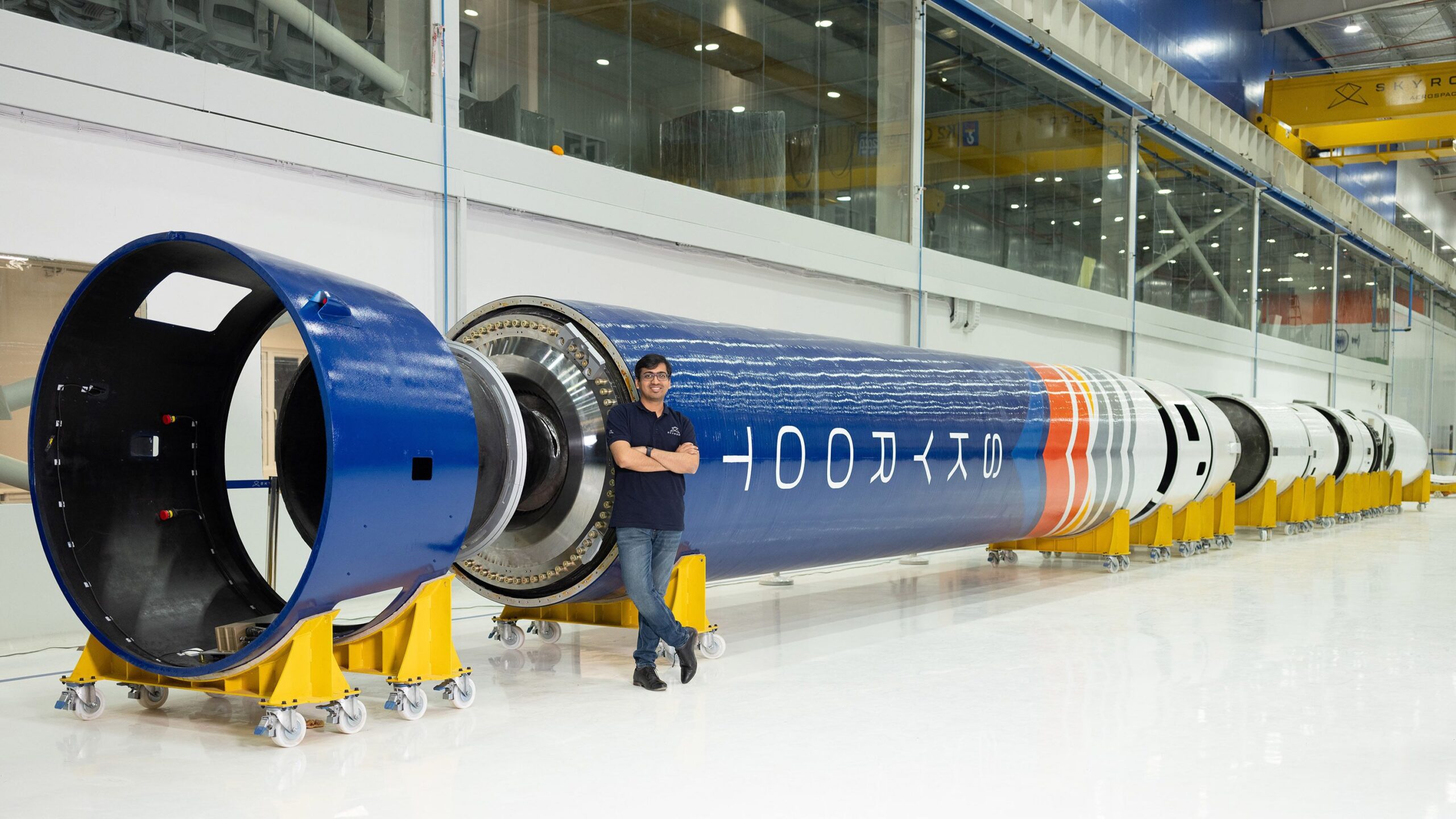
Meet Vikram-1: India’s First Private Orbital Rocket
If Infinity Campus is the factory, Vikram-1 is the flagship product rolling off its floors.
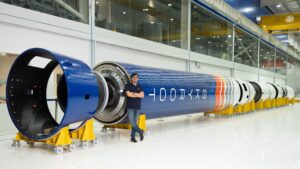
Unveiled by PM Modi during the inauguration, Vikram-1 is India’s first privately built commercial orbital rocket, fully designed and manufactured in the country.
Vikram-1 at a glance
-
Type: Small-lift orbital class launch vehicle
-
Payload:
- Up to 480 kg to a 500 km low Earth orbit (LEO, low inclination)
- Around 290 kg to a 500 km Sun-synchronous polar orbit (SSPO)
-
Architecture:
- Solid-propellant lower stages
- A liquid-propelled upper stage for precise orbital insertion
-
Tech highlights:
- Carbon-fibre structure for lighter, high-performance stages
- Kalam-1200, one of India’s largest privately built rocket stages
- Advanced 3D-printed engines and low-shock separation systems
Skyroot is targeting Vikram-1’s maiden launch by early 2026, aiming to carry multiple small satellites to orbit and kick off a cadence of frequent, commercial launches.
When that rocket flies, there’s one line you can’t ignore:
“Designed and built in Hyderabad.”
From Kondapur Cubicles to India’s Most Ambitious Space Startup
Long before Infinity Campus, there was… a small office and a big leap of faith.
-
Founded: 2018
-
Founders: Pawan Kumar Chandana and Naga Bharath Daka, ex-ISRO engineers and IIT alumni
-
Origin: Started up in Hyderabad’s ecosystem, leaning on local enablers like T-Hub, CIE and the Telangana innovation network
-
Breakout moment: Vikram-S (Mission Prarambh) — India’s first privately built rocket to reach space, launched in November 2022
Today, Skyroot is:
-
Among India’s most well-funded private space startups, backed by marquee Indian and global investors
-
Employing a rapidly growing team across engineering, manufacturing and operations
-
Building a pipeline of carbon-composite rockets and 3D-printed engines, with a goal of regular, repeatable commercial launches over the next few years
Why Infinity Campus Is a Big Deal for Hyderabad’s Startup Ecosystem
Looking at Skyroot purely as “space-tech news” is one thing.
Looking at it as Hyderabad’s startup story is another.
Here’s why Infinity Campus matters far beyond aerospace:
1. Deep-Tech Manufacturing, Not Just Software
Infinity Campus proves that Hyderabad can host highly specialised, capital-intensive manufacturing:
-
Carbon-composite rocket stages
-
3D-printed engines
-
Precision avionics
-
Integrated launch vehicles
This opens doors for ancillary startups in materials, sensors, testing, embedded systems and industrial automation.
2. Talent + Policy + Capital = Global Play
Skyroot sits at the intersection of:
-
ISRO-trained talent
-
Progressive space policy and reforms that opened the sector to private players
-
Global capital betting on India’s space ambitions
That formula can be replicated in defence-tech, climate-tech, robotics, semiconductors and more — all from Hyderabad.
3. A New Value Chain Around Space
A rocket factory is not just about rockets.
It pulls in:
-
Satellite makers
-
Earth-observation and analytics startups
-
Ground-station and communication players
-
SaaS companies building mission control, telemetry and ops tools
-
Simulation, testing and digital-twin platforms
Expect second-order startups to emerge around Skyroot, much like how big consumer-tech players once spawned entire ecosystems around them.
4. Brand Hyderabad, Now in Orbit
Swiggy put Bengaluru on the food-tech map.
Zomato put Gurugram on the global dining grid.
Skyroot does that for Hyderabad + space-tech.
Every time Vikram-1 flies, and every time an international outlet says “Hyderabad-based Skyroot Aerospace…”, it nudges investors, engineers and founders to look at this city differently.
What Founders in Hyderabad Can Learn from Skyroot
In classic StartupHyderabad style, here are a few entrepreneurial takeaways from Skyroot’s journey so far:
-
Chase hard problems, not just hot trends
Space launch is literally rocket science. But that also means high barriers, deep moats and global markets. -
Leverage your ecosystem ruthlessly
From ISRO experience to Hyderabad’s innovation hubs and Telangana’s policies, Skyroot has used every advantage well. -
Invest early in infrastructure, not just MVPs
Infinity Campus is a bold move — a sign that they’re building a launch business, not just a one-off rocket. -
Tell a big, global story from Day 1
Vikram-1 isn’t only for Indian payloads. Skyroot is clearly eyeing global small-satellite customers and competing with international launch providers. -
Stay mission-driven, not vanity-driven
The company could have stopped at being “first private rocket to reach space.” Instead, it’s doubling down on reliable, repeatable commercial launches.
Watch: Front Page by AIM Breaks Down the Big Moment
To go deeper into Skyroot’s Infinity Campus and Vikram-1, check out this episode of Front Page by Analytics India Magazine, which explores:
-
How Infinity Campus is designed
-
What makes Vikram-1 unique
-
How Skyroot wants to get to high launch cadence over the next few years
Closing: Hyderabad, Say Hello to Your Space Age
From Kondapur cubicles to a 2 lakh sq. ft rocket campus and an orbital rocket ready to fly, Skyroot’s story feels very familiar to this city — just operating at escape velocity.
Hyderabad has already shown it can build world-class products in coupons, gaming, adtech, SaaS and fintech.
Now, it’s building something else:
A launchpad. For satellites. For founders. For India’s private space race.