Hyderabad-based Skyroot Aerospace has hit a historic new milestone.
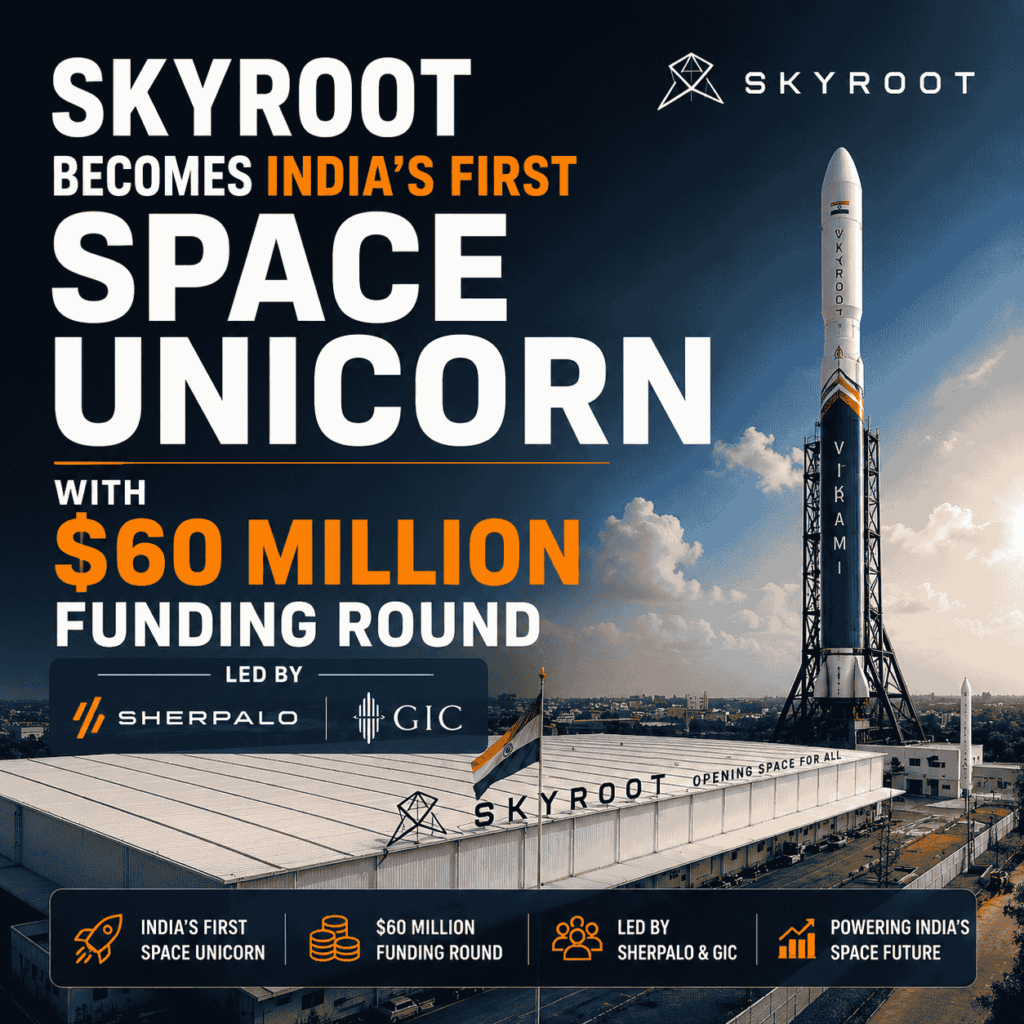
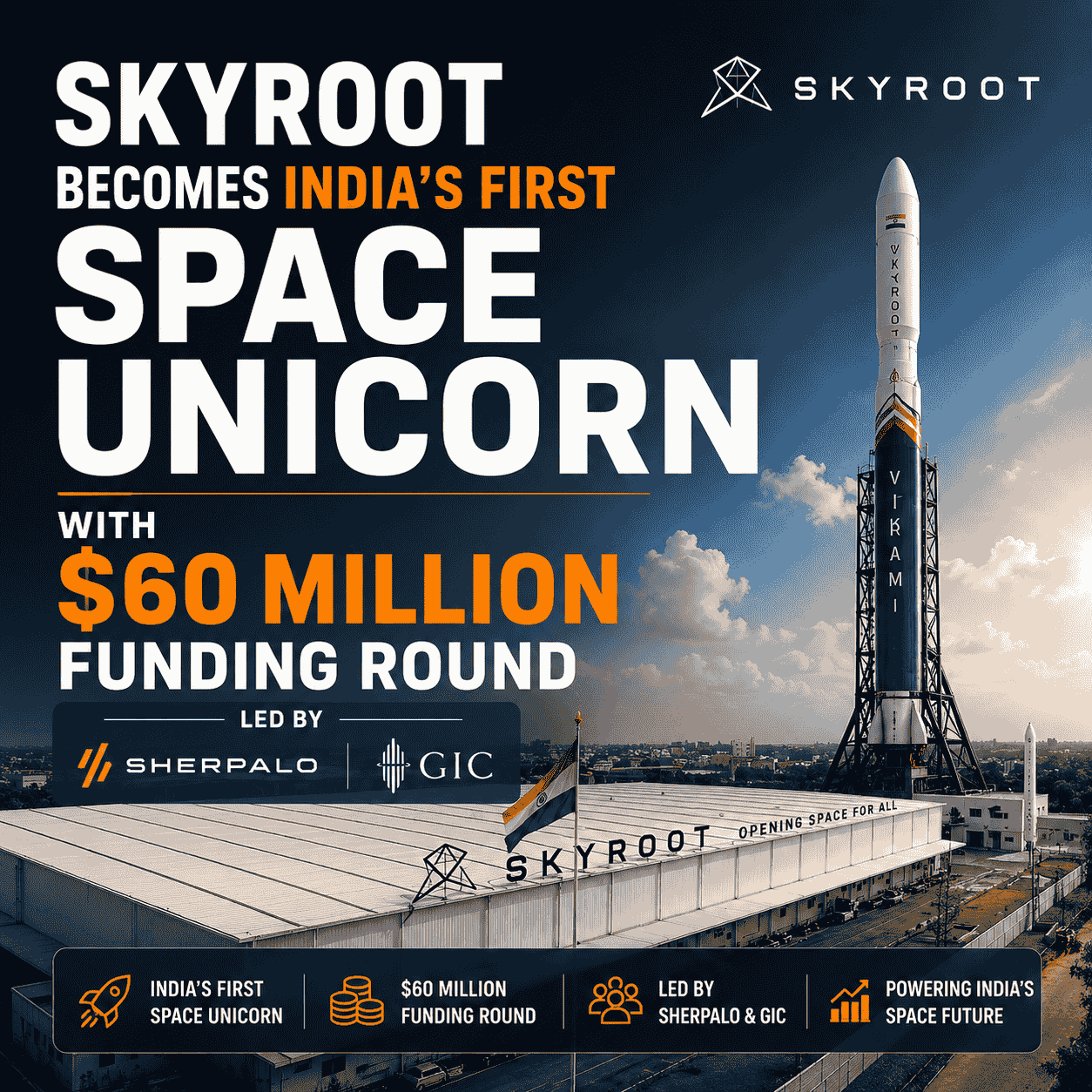
The private space startup has raised $60 million at a valuation of $1.1 billion, officially becoming India’s first spacetech unicorn. For Hyderabad’s startup ecosystem, this is more than a funding headline. It is a strong signal that the city is not just producing SaaS and deep-tech companies anymore — it is producing globally relevant space-tech giants.
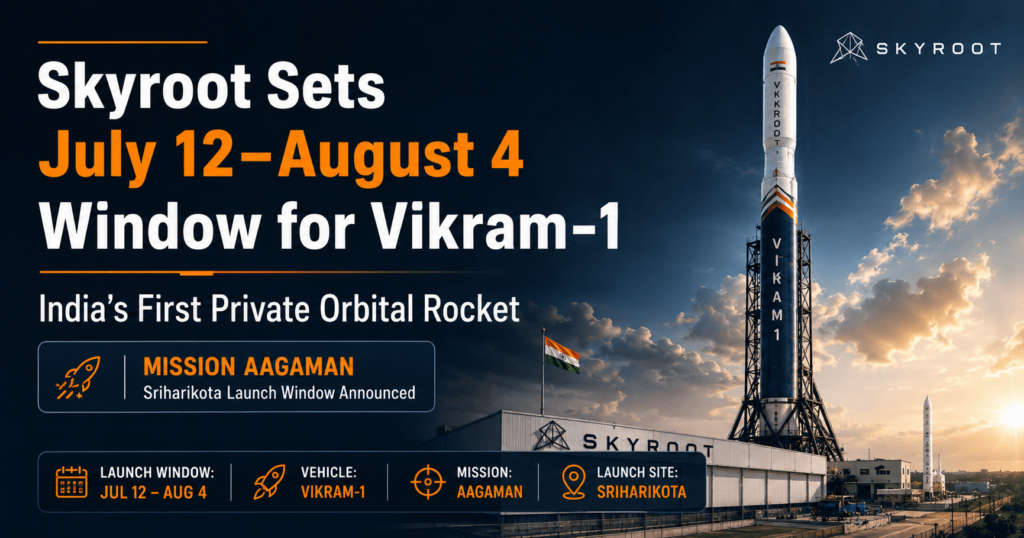
Even more importantly, the timing of this raise makes the story bigger. Skyroot says Vikram-1, India’s first privately developed orbital rocket, is now just weeks away from its maiden flight. That means this is not capital raised on pure promise. It is funding coming in at a moment when the company is getting ready to move from proving technology to scaling commercial launch operations.
A Defining Moment for Indian Spacetech
Skyroot’s latest round marks a turning point for India’s private space sector.
The company has raised capital from a high-profile set of backers including Sherpalo Ventures, GIC, funds managed by BlackRock, the founders of Greenko Group, Arkam Ventures, Playbook Partners and Shanghvi Family Office, among others.
That kind of investor lineup says a lot. It shows that private capital now sees Indian spacetech as a serious long-term category, not just an experimental frontier.
For years, India’s space story was almost entirely identified with ISRO. That is now changing. Startups like Skyroot are proving that India can also build venture-backed, globally competitive private space companies with strong technology, clear commercial demand and the potential to scale.
Why This Funding Round Matters
According to Skyroot, the new capital will be used for three big priorities:
- Scaling launch cadence for Vikram-1
- Expanding manufacturing capacity
- Developing Vikram-2, a next-generation launch vehicle with a 1-tonne class capability and an advanced cryogenic upper stage
That tells us this round is not just about runway. It is about acceleration.
Skyroot is preparing for the next phase of growth, where success will depend not only on launching a rocket once, but on building the systems, teams and infrastructure needed to launch reliably and repeatedly.
In space-tech, that shift matters. A single successful launch creates headlines. A repeatable launch business creates an industry.
Vikram-1: The Mission Everyone Is Watching
At the centre of this moment is Vikram-1, Skyroot’s orbital launch vehicle.
The rocket is expected to be India’s first privately developed orbital launch vehicle, and its maiden flight is now being positioned as imminent. If Vikram-S in 2022 proved Skyroot’s technical capability through a sub-orbital mission, Vikram-1 is expected to take that story to the next level by taking payloads to orbit.
That is a huge jump in both complexity and commercial value.
Skyroot has built its company around a simple but powerful belief: that satellite operators around the world need reliable, affordable and dedicated access to orbit. Vikram-1 is the vehicle through which that belief gets tested in the real market.
For global customers launching small satellites, launch flexibility and cost efficiency matter deeply. If Skyroot can deliver that consistently, it will not just be an Indian success story. It will become part of the global launch conversation.
Hyderabad’s Startup Story Just Got Bigger
This is also a landmark moment for Hyderabad.
Skyroot becoming India’s first spacetech unicorn adds a whole new dimension to the city’s startup identity. Hyderabad has already built a reputation across enterprise tech, SaaS, gaming, healthtech and deep-tech. Now it can point to something even more ambitious — a homegrown private space company crossing the billion-dollar mark while preparing for orbital launch.
That matters because startup ecosystems grow stronger when they produce category-defining companies.
Skyroot is doing exactly that.
It shows that Hyderabad is capable of supporting:
- highly technical product companies
- capital-intensive deep-tech ventures
- globally ambitious founders
- long-gestation innovation with real commercial potential
In many ways, this is the kind of company that changes how investors, talent and policymakers look at a city.
From Vikram-S to Unicorn Status
Skyroot’s journey has been unusually fast, but not accidental.
The company first grabbed national attention in 2022, when Vikram-S became India’s first privately developed rocket to launch successfully. That mission established credibility and gave the broader Indian startup ecosystem something tangible: proof that private space innovation in India was not just theoretical.
Now, just a few years later, Skyroot has:
- raised $60 million
- reached a $1.1 billion valuation
- become India’s first spacetech unicorn
- and moved within weeks of the Vikram-1 orbital mission
That kind of progression is rare in any category, let alone one as technically demanding as aerospace.
What This Says About the Market
There is also a larger market signal here.
Investors are not backing Skyroot only because rockets are exciting. They are backing the company because the space economy is changing.
Satellite demand is rising. Small satellite launches are becoming more important. Governments and private operators are looking for more launch options. And countries like India are increasingly positioned to offer high-quality engineering at globally competitive costs.
Skyroot sits at the intersection of all of that.
Its value proposition is not just “we build rockets.” It is:
- we can help open access to orbit
- we can do it from India
- and we can do it in a way that is reliable, commercial and scalable
That is why this round matters far beyond one company.
It reflects growing confidence in the idea that India can create globally important infrastructure companies in sectors once considered too complex for startups.
The Road Ahead
Of course, the next chapter will depend on execution.
The real test now is not the announcement, but what follows:
- a successful Vikram-1 maiden flight
- the ability to scale launches
- expansion of manufacturing and operations
- and progress toward Vikram-2
If those pieces come together, Skyroot could move from being India’s first spacetech unicorn to being one of the country’s most important deep-tech companies overall.
And if that happens, this funding round will be remembered not just as a milestone, but as the moment when India’s private space race truly entered a new phase.
Closing Thought
For Hyderabad, Skyroot’s rise is a proud moment.
For India, it is a reminder that world-class technology companies can emerge from here in sectors far beyond software.
And for the global space industry, it is a message worth paying attention to:
India’s private launch era is no longer coming. It has arrived.